In my blog I plan to chat about nature, crafts, baking, gardening, beekeeping, family, and whatever else seems appropriate at the time. Sit back, relax, and enjoy!

Showing posts with label swarms. Show all posts

Tuesday, May 31, 2016

Bee Situation! 2016

 For those of you who follow my blog, or remember Indiana weather in March, 
Easter Sunday was beautiful.  We were outside in short sleeves!
 I had five hives and they were all alive and buzzing.  
Then the following weekend, this happened.
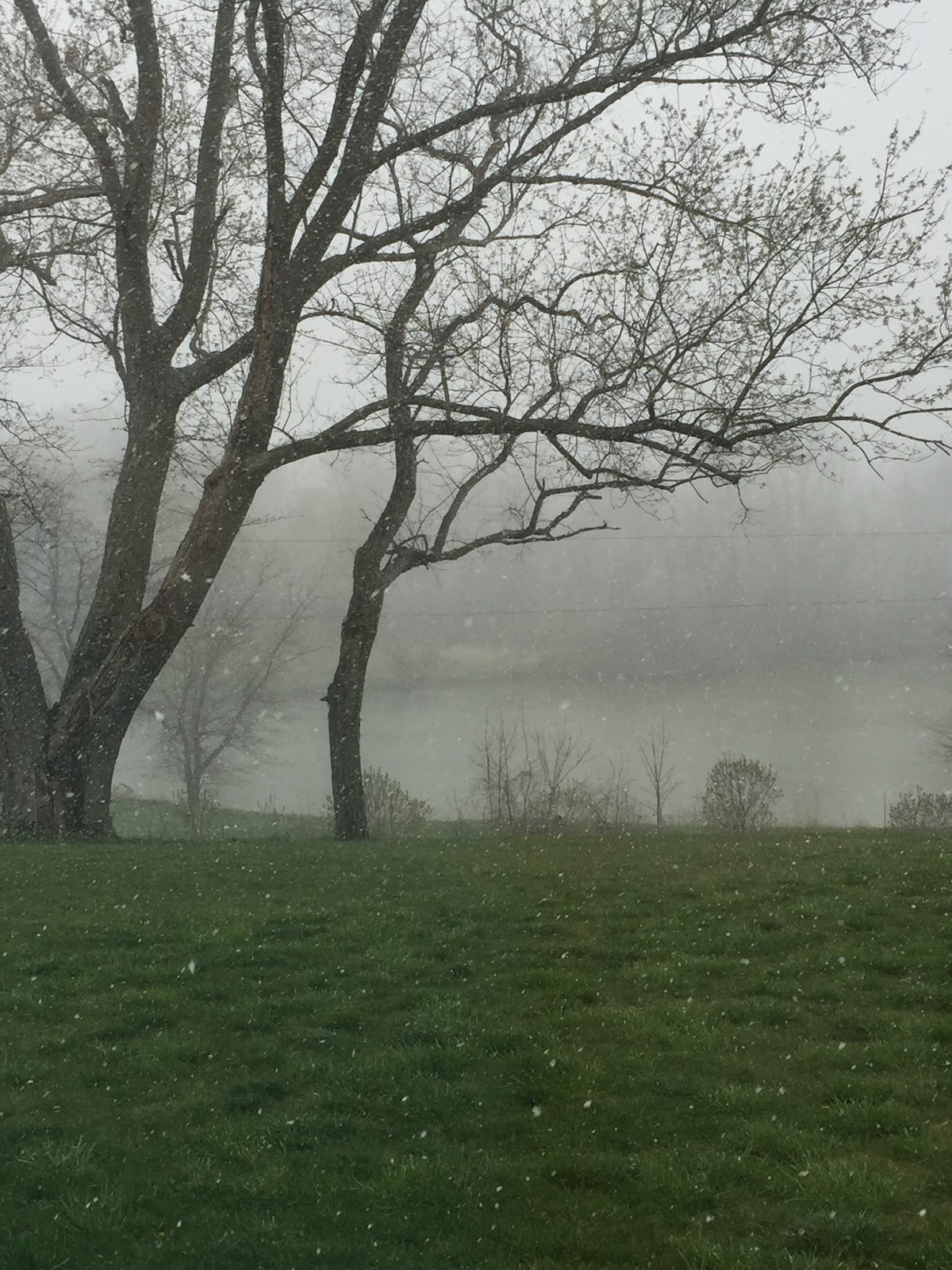
 And it was bad.  My parents, who live closer to town, lost power for hours.  They tried to  make it to our house and couldn't because the storm picked up so much they couldn't see to drive.  You couldn't even see the pond across the road.  In this picture you can still see it.  It would sleet, then rain, then hail, then snow - sideways!
 A few days later I remember trying to beat this storm home.
 Two weeks after Easter, more snow.  You can see in this picture how green our grass was from all of the warm weather, then we get snow and cold, and if it wasn't snowing it was raining, almost the entire month of April. 
This robin looked up at me and chirped, "WTH?" Bee Lady?  
"I know, right."
"It's Indiana."

 Sad to say, I lost four out of five hives during the first two weeks of April.  I called my mentor beekeeper friend because I was so distraught.  He told me it happened to A LOT of beekeepers and there isn't anything we can do about it.  What happened was the Queen started laying eggs as though it were summer.  It felt like summer!  And the bees could not maintain the warmth they needed in their little bee cluster to stay alive. 
 Vickie and I spent an entire day taking down dead beehives and extracting the honey left over from winter out of the hives. It was a long, sad day.  
 
I had the one hive left and I was praying no more cold weather.  I opened it one day and just wanted to cry because the queen was not laying.  I found out that was a good thing.  She wasn't laying because it was too cold out for the amount of bees in the hive to keep any more brood warm. 
 How smart are these creatures!

So, I had one hive, and I had an empty hive set up with the frames we extracted.  And would you believe a swarm helped themselves to that empty hive! What luck!
So I was back up to two hives. 
Mid-May, My Shug and I decide to escape to warm weather in Florida!

 I'm sitting by the pool enjoying this drink...
And I get a call!  Someone has a swarm! 
Are you kidding me! I'm almost 800 miles away and I get a swarm call.
 Now, my cousin Vickie and I joked about her getting a swarm for me while I was gone.  
I told her she COULD do it!  
We even joked about a 
bee mantra for her to say while she was getting the swarm.

Breathe.... Bzz Bzz
Breathe.... Bzz Bzz

And when the owners sent me this picture of this swarm I KNEW SHE COULD DO IT!
My Shug was floating in the pool, "Don't send her after that."
"She can do it" (My fingers were flying on my my phone e-mailing her)
No she can't, he says.
She can too.....She's helped me for years, I say (I'm texting her) 
I'm begging her to call me.  
She was at work, she had a game to work that night (she's athletic something or another where she works)
and after all of that......

I think it's the third swarm in my history of beekeeping that didn't require a ladder! 
Her husband is helping her! 
(THANK YOU AGAIN VICKIE AND ROBERT!)
  Just like a pro!
Hive number three!
  Then on the way home from Florida I got a text from someone who has bees in a whiskey barrel on their front porch.
 We went to get the bees and decided to come back that night and get the barrel instead.  When you are getting a swarm, it's best to do it during the day when the sun is shining and they are occupied looking for a home.
When you move a hive, even if it's in a whisky barrel, you should do it at night when the bees are inside.  So, we were not even home for 24 hours when we were off getting a whisky barrel of bees.
We brought it home that night, and the next day in the sunshine (when the bees were occupied) My Shug sawed the lid off of the barrel.
 Unfortunately, the comb was on the lid and it fell into the barrel.  Which had apparently housed robins for years and years.  PeeYew! stinky  But look at all those bees!

 I won't go into the details of how I did this, unless there is a beekeeper out there that needs to know.
 But it worked!
 After a few days, no bees in the barrel, and all the bees were in the hive!
Hive number four!
We returned the barrel to the owners and they were happy to not have bees. They were also going to keep the hole to the barrel plugged up.
 And yesterday, Vickie and I split a hive that was FULL!
It took us two hours to find the queen.  Hot, Heavy, Hard work.
When you split a hive, you do it in the sunshine and you do it in hopes that the hive will not swarm from becoming too full.  This was the hive that had just moved into my empty hive body that was in the yard. 
So now I'm back up to five.
(If this split works)
I don't know how much honey I will have this year.  I'm starting with new hives again. And I know, most people want the honey.  I, however, want the bees.  
And I'm going to do everything I can to increase my hives so that I have bees. 
Beekeeping is not only hot, hard, and heavy work, it is also emotional.  I was so excited this year to get into beekeeping again.  Not that I quit, but the last few years I was always beekeeping in a hurry, with the house always on my mind.  
After going to the big beekeeping meeting in February, I was anxious to get started and I want to learn all I can.  I want to try new things.  I remember that day, only a month ago, I was choking back tears, to now, when I'm a happy bee lady once more!

Cindy Bee 

PS. I know, I know...this is not short and sweet.  C'est La Vie as my sister would say.

Friday, April 15, 2016

Swarm days are almost here!

 Five ways to tell the difference between honey bees and other stinging insects!

I get phone calls every year from people claiming they have a swarm of honeybees that they want me to come and get.  I'd guess 90% of those calls are not honeybees. I've already received a call this year...it was not honey bees.  But in the next few weeks, it's possible you will see a swarm of honeybees.  They have a swarming season, and it's usually the end of April, or the month of May, in our area, depending on the weather.  I would like to show you some ways to identify honey bees.

 Last year I got a call from a friend who thought she had honey bees in her house.  She had something in her house, but these are NOT honeybees.
  They are yellow jackets or wasps and they made a mess in her house. 

1) Honeybees do not make this kind of a mess in a home.  If they get into a house, it's usually in the walls or the attic space and they will build wax comb, not this papery mess you see here.
  I suggested she call an exterminator.  Wasps and yellow jackets are not friendly.
(Look at the wasp on the screen.  The body is more jointed than a bee, and skinnier)


2) This (below) is what we used to call paper wasps.  I'm not sure if that is the official name, because I am not that knowledgeable when it comes to yellow jackets or wasps.  I am not a keeper of yellow jackets or wasps! 

Honeybees do not live here!

3) If you see something like this hanging on a tree, get the H out of there QUICK!  This is probably a hornets nest.  I did not get close enough to find out if it had a live nest in it!

Honeybees do not live here! 

4) Honeybees do NOT live in the ground.  I've had several people swear they have honey bees coming out of the ground, but they don't.

If you look at this picture I got off of the internet, you can see honey bees are a little more muted in color than wasps and yellow jackets and they are a little more fuzzy looking.  I know you are thinking you won't get close enough to tell, right!
 

5) A honey bee will not sting you unless she has to defend herself or her hive, and once she stings you, she will die.  Not so with a wasp or a yellow jacket.  They can sting over and over again and they don't die from stinging you.
 Most of the time honey bees will be on flowers, they only want nectar and pollen from plants.  Yellow jackets and wasps are carnivores (and junkavores).  They will eat your steak, your ice cream (they are the "crazy bees" that won't leave you alone in the fall) and they will even eat a honey bee!

SWARMS
Most honey bees are not found in the wild anymore.  However......
 If you see something like this (picture below) hanging on a tree, call a beekeeper or your local extension office.   They are honey bees and even though this is what a swarm usually looks like, it is not actually a swarm.  This happened to be a bunch of honey bees that built a hive on the outside of a tree.  They would never have lasted the winter. 


This is a swarm and it's probably the biggest swarm I ever retrieved. Usually they are football in size or bigger, if they are worth getting.
Here I am holding it.  Swarms are not mean.  I did not get one sting getting this swarm.  These honeybees are protecting their queen and looking for a new home.  Look closely and you can see bees flying around all over the place.  I was waiting for them to calm down, then I was going to put them in the cardboard nuc box until I got them safely home and into a hive that I had waiting for them.

This is another swarm.  Sometimes they aren't that easy to see, but you might hear them.  Or, if you're lucky, you'll see a "cloud" flying quickly across the sky and landing in a tree.  

 This is a horrible picture of me!  I think I was painting when this guy called me to come and get this swarm.   If you see a swarm, you have anywhere from three hours to three days to get a beekeeper to come and get the swarm.   SO CALL SOMEONE IMMEDIATELY!

We were standing under she swarm.  Which shows how docile they are when they are in swarm mode.
Here they are, hidden in the tree being all nice and quiet like.
 
If you are ever in a situation where you aren't sure, it's always best to call a beekeeper or your local extension office.  It's a special day when you see a swarm because it doesn't happen often, and it's very special to watch a beekeeper capture one.

I am connecting with Amy at  Five on Friday!  Click here to see what other bloggers are up to.

Cindy Bee

Friday, April 10, 2015

Three things EVERYONE can do to help nature

A couple of weeks ago, I contributed to an article in our local newspaper about honeybees and butterflies.
 I've contributed before, but I was pretty excited about this article when I read it.  
Not because of me being in the paper, but because of some of the other people that were in the article! It was an honor for me to be a contributor in the same article as these people. 
And it made the entire front page of the Sunday paper.
The reason this article is of concern to so many people, is because if we keep doing what we've been doing, we are 
NOT GOING TO HAVE ANY BEES AND BUTTERFLIES left.
Rather than reiterate what was said in the article you can click HERE and read it.

Let me start out by saying, I know it's hard to change the mindset of people.  Everyone wants to see butterflies and honeybees and such, but they also want their yard to look like a golf course.  
Why?
How many honeybees/butterflies do you see sucking nectar out of a blade of grass?
And why do we obsess over grass?
Personally, I think this is much prettier!

 I don't think  "Little House on the Perfectly Manicured Yard" has quite the same ring as "Little House on the Prairie" do you?
 All of these pictures were taken by me and they are on our land, except for the picture of the swarm.  We do not have the golf course lawn.  We do have clover and dandelions, which bees love.  Seriously....people boast about getting "clover honey" yet they are the same people who spray chemicals on the clover in their lawn!
 We also have milkweed, goldenrod, and Queen Anne's Lace.
 We do have a small acreage of land, but what can you do if you have a small yard or live in town?


I'd like to tell you three things YOU CAN DO
to help nature, that did not make the article.

1) Pick one small area of your yard and let it grow native.

 Think of it as an experiment.
No chemicals.  
See what kind of wildlife that one little area attracts. 
 Just one area.
 True Story - We have a neighbor that sprays his huge golf course yard.  He was devastated when his dogs died. Two huskies. One from cancer of the mouth, one from cancer of the eye.  Now think about this...when your animals walk on the ground, where do they usually put their head....face....mouth....


Did you know if monarch butterflies do not have milkweed, they will not survive?  Monarchs lay their eggs on milkweeds plants, the eggs hatch and as larvae they eat the plant. Monarch butterflies are smart enough to know they HAVE TO LAY THEIR EGGS ON MILKWEED PLANTS! Milkweed used to grow by fence rows, but so many plants that we consider weeds are being exterminated.  By exterminating all the milkweed, you are exterminating the monarchs.  
It's the circle of life peeps.

Yup...this is our fence row.
 This is a butterfly bush in our yard.   In the late summer we saw hundreds of butterflies between the milkweed, the butterfly bushes, and the fennel and dill plants.  Hundreds.  If you want to plant a butterfly garden don't forget about host plants for the butterfly larvae.
Honeybees love goldenrod in the fall and it makes a very rich honey.
 

2)  The second thing you can do is IF YOU SEE A SWARM OF BEES CALL YOUR LOCAL EXTENSION OFFICE or a local beekeeper.  Look up the phone number now and keep it handy.  Don't kill them!  Below is a picture of one of the biggest swarms I've ever gotten.   They are usually the size of a football.  And most bees will start swarming in May.  There are more people getting into beekeeping because the media has finally caught on to the loss of our honeybees, and people realize they can raise bees in town.  More beekeepers mean more swarms.  This is one of the most docile states honeybees are in.  I've never been stung getting a swarm of bees.  They will hang around like this anywhere from three hours to three days, so call someone as soon as  you spot it.  It's very exciting watching a beekeeper get a swarm.  And if you call me, I usually bring an extra suit and let you be a part of the experience if you want to.
 

3)  And this is a hard one.  Buy your seeds from a reputable organic company.  

There are several now.  Two I know of are Seed Savers Exchange and Seeds of Change.  There are dozens more.  And some stores sell organic seeds now.  The reason this is hard for me is because when I go to a garden center to buy a plant, I see it, I like it, I buy it.  But this should change the way people purchase plants.    Many plants have already been genetically modified with pesticides. (gmo's) When you buy a plant that has been genetically modified with pesticides, and a honeybee or butterfly sucks the nectar from that plant, it will die.  And guess what?  They will not be labeled genetically modified.  

Didn't someone stop to think that there are good bugs out there, that WILL DIE, just as easily as the bad bugs?  
Sometimes you just have to stop and wonder
what were they thinking?

Cindy Bee

Tuesday, September 17, 2013

A Swarm Lesson - read it even if you aren't interested in bees....to educate yourself! You could get a swarm whether you want one or not!

 I've received three calls in the last two weeks to come and get "swarms".  I don't usually bother in the fall, unless people touch my 'sympathy nerve'.  Here's why...most of the calls are not honey bees (see post before this one), they are usually yellow jackets, and most swarms are about the size of your fist in the fall.  Not big enough to make it through the winter and not worth my time.
One call on Saturday was from a guy who is doing construction work and "cannot continue until the bees are gone".  And it was only three miles from our home, so I went.  On the phone he said the swarm darkened the sky, it was like a huge cloud.  I said that is unusual for this time of year.  This is what I saw when I got there.  

 Honey Bees were flying in and out of this hole. 
 
I'm wondering where the swarm is, so I asked...and found out...."it was huuuuggge"....."in June."  Peeps, if you see a swarm of bees land somewhere, In JUNE, call your local extension office in JUNE, IMMEDIATELY, and get the name of a beekeeper to come and get the swarm. If you don't have an extension office, call the police dept., fire dept., local beekeeping association, etc.  How do you know if it's a swarm of bees....it does look like a dark cloud flying quickly across the sky, and when it lands, it's usually the size of a football. Watch where it lands and make a call.

Here's the thing about swarms.  They don't usually bother you if you don't bother them.  The swarm will stay where it lands anywhere from three hours to three days. Then it moves on.  It could go into the house it landed on, into your house, a barn, a dead tree, you get the idea.  But once they get in the house, they are hard to get out without tearing the house apart.  These bees are flying in this hole, but after removing the osb wall, we saw no sign of a hive.  You know why?  Because they are much smaller than a human, and newsflash, they can fly.  That hive can be anywhere in the attic or walls at this point.  They might fly in this hole, but who knows how far back they go.  They've been building a hive since June in this house!  There could be 60-80 pounds of honey in that house!

He asked if he could kill them.  Sure...go ahead....if you can find them.  Then, next year, plan on killing wax moth.  Click on wax moth for pics.   Because once you have an unprotected hive, wax moth will move in.  Ask a beekeeper.  Ask my friend Marcia.  Ask you, since you've read this!  Your local exterminator knows this, but he probably won't share that information.  But when he leaves he'll hand you his business card with a smile, "in case you have any more problems".  He knows you will....you now have an empty hive in your house. I don't know the people that owned this house, but you can tell by the way they take care of their house, they are very lax about things.  They should have made the phone call in June.  I left.

The second call, which came within ten minutes of the first call, was from a man who owns a local excavating business.  He keeps my name and number on hand, because every now and then he tears down a house that has a hive in it.  He doesn't usually know the house has a hive in it, until it's on the ground, which is unfortunate.  You can see a post here from another time he called me to get some honey bees. 

 This trip was not as successful as the last time.  This is all the bees that were left.  Not worth driving to the other side of town.  I picked them up and put them in a box, but there weren't enough bees to mess with really.  And NOTE that the owner of the excavating business is not the owner of the house.  And the owner of the house had no idea that the owner of the excavating business called a beekeeper. When I got there the homeowner said, "what a great idea."  But when one of the people hanging around said, (use your doofus voice here) "yeah, a couple uh weeks ago those bees started coming at us so we sprayed 'em.  Think we coulda killed the queen then?"  I left.

I wasted my entire day.  Those "swarms" which weren't swarms at all, were in different counties, and on opposite sides of town.  Not worth the trip.  When you call a beekeeper to get a swarm, educate yourself, make sure it is a swarm.  And guess who else learned a lesson or two here?  Me.

Go here and here for real swarm stories or to see what a swarm looks like.

Cindy Bee